


“The people who wade into discomfort and vulnerability and tell the truth about their stories are the real badasses in this world.”
Dr Brené Brown
In your organisation, culture or family, how do you navigate giving or getting feedback or talking about difficult topics? Is there a commitment to normalising and leaning into the deeply uncomfortable vulnerability of saying hard things out loud? Or is there avoidance, silence, and judgement? Or are there negative repercussions for saying the unspoken?
Most of us haven’t been taught how to navigate talking about difficult topics, so we either stay silent, or we offload our thoughts and feelings in unhelpful ways. The good news is that we can learn how to speak the things that need to be spoken.
Normalise tough conversations
I believe many of us hold a belief that we can get through life without having hard conversations. That if we’re ‘good’ or ‘perfect’ or ‘accommodating,’ we can glide through the world without the discomfort of friction. We trick ourselves into believing that ‘good’ cultures and relationships have rounded edges and smooth terrains and are devoid of crevices, woods and crags.
The truth is great organisations aren’t devoid of intellectual friction. Instead, they normalise rumbling with it. Friction is often the spark where creativity, innovation and change happen.
Let’s rumble
A great way to normalise tough conversations is to name them. In Dr Brené Brown’s research in Dare To Lead™, she defines a ‘rumble’ is a space where we give ourselves permission to talk about difficult, messy or uncomfortable issues without knowing where the process will take us while holding space for curiosity, generosity and accountability.
She explains how the word ‘rumble’ is a cue to drop the ego:
“A rumble is a discussion, conversation, or meeting defined by a commitment to lean into vulnerability, to stay curious and generous, to stick with the messy middle of problem identification and solving, to take a break and circle back when necessary, to be fearless in owning our parts, and, as psychologist Harriet Lerner teaches, to listen with the same passion with which we want to be heard.
More than anything else, when someone says, “Let’s rumble,” it cues me to show up with an open heart and mind so we can serve the work and each other, not our egos.
‘Rumble?’ Really?
Sometimes, when I introduce the concept of ‘rumbling,’ people wince. I hear comments like:
- It sounds confrontational and aggressive.
- It feels too American for me.
- Rumbling isn’t going to work for us a concept – we’re a professional football team and we’d literally roll around on the grass with each other if we said, ‘let’s rumble.’
- “LET’S GET READY TO RUUUUUMMMMMBBBBLLLLLE!”
If this is you, I offer you a few ideas.
Think of rumbling like a pot of pasta water – a rolling boil that has some energy and heat that needs tending to. What energy needs investigating?
And/or…
Our tummies rumble when we’re hungry and need sustenance. Rumbles are a sign of a living system that needs care and input to keep going strong. What needs nourishing?
And/or…
Have you watched the film Jumanji? The distance drums rumbling in the background are a call to pay attention to what’s happening because you’re going to need to jump into action soon.
In a team workshop with lawyers, when I introduced the concept of rumbling, they said ‘oh yes, we understand that healthy debate is necessary for shared understanding and building ways forward. It’s part of professional practice.’ We don’t need to be lawyers to appreciate that putting forward ideas for respectful exploration is necessary for good work.
I once had a participant who misheard me pronounce ‘rumble’ and said, ‘do you mean rumba?’ What a happy accident that was because I think this kind of conversation can also be like a Cuban ballroom dance. Cha! Cha! Cha!
If the concept of rumble still doesn’t fly for you, find your own word that helps set the intention of an uncomfortable, brave conversation. I’d invite you to stay open to the concept, its intended meaning and the possibilities it can unlock.
One participant once told me that her boss called these kinds of chats ‘care-frontations’ – as in ‘I care enough about you, your growth, development, reputation and impact to have this uncomfortable conversation.’ I love this so much, as it helps centre as a core value of leadership, and reminds us of the purpose of leaders – to have the courage to develop the potential in people and processes. To care enough to effect change.
When we opt to rumble with someone about an issue, we’re signalling that the relationship matters enough to do the work. We’re also accepting stepping into the unknown.
Above all else, normalise, normalise, normalise these types of conversations as essential to build a high-performance, high-care culture.
How to rumble
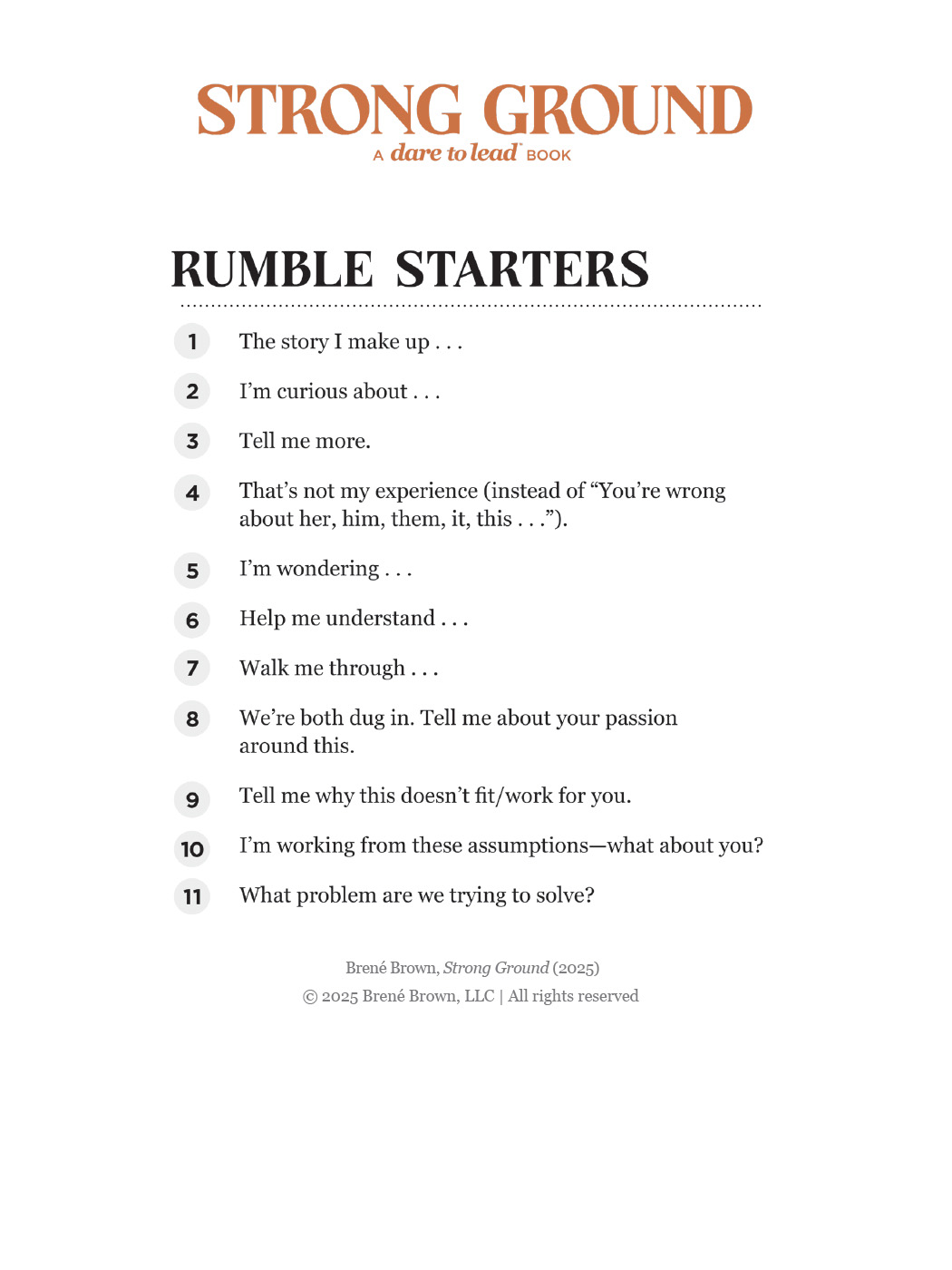
The key to rumbling is language that embodies and invites genuine curiosity. To ask good questions and model intense listening. It’s to always be a learner. I remember the first time I read through this list, I could hear my most judgmental, accusatory tone in the words ‘Help me understand…‘ that did not express curiosity at all – the words were saying one thing; my delivery said something entirely different! So I encourage you to practice these and see them as a cue to get curious before you get furious (hopefully, you’ll head off ‘furious’ by using them!). In the Dare to Lead™ program we use rumble starters to help open up and shape a conversation that’s inclusive of different perspectives. Download the list from Brené Brown’s website here.
A rumble is vulnerability in action
At the heart of daring is a deeply human truth that is rarely acknowledged: courage and fear are not mutually exclusive. Most of us feel brave and afraid at the same time. We feel vulnerable. Sometimes all day long. As psychologist Susan David says, ‘Courage is fear walking.‘
During those moments when we’re pulled between our fear and our call to courage, we need shared language, skills, tools, and daily practices that can support us through the rumble. This shared understanding helps steer us away from potentially harming someone else with our words.
How do we avoid shaming others in a rumble?
The intention behind a rumble is to address difficult issues in a safe space by centring curiosity and discovery with humility and generosity.
We try to avoid shaming the other person by asking genuinely curious, open questions and focussing on the behaviour itself. Yet despite our best intentions to avoid shaming other people, they may experience shame of their own accord. We all have shame triggers – some of us are more aware of them than others. When experiencing shame, some people may shut down, or become defensive, or perform, please and appease.
The antidote to shame is empathy and self-compassion. As a leader, you have an opportunity to sit in the seat of empathy with the people you lead.
Empathy can sound like:
- I get it. It can be hard to get this kind of feedback. Where would you like to go from here?
- I know these conversations can feel tough. I’m really grateful we can have them.
- I see you’re trying. I’m with you.
- That sounds frustrating. I would have felt that way too.
- This feels awful. We’re uncovering something important. Let’s acknowledge these hard feelings and what’s behind them so we can move through them.
- What does support look like to you?
- When can we circle back to see how you’re progressing?
You also have the opportunity to model self-compassion. Self-compassion can sound like:
- I make mistakes too. It’s part of being human. Our job isn’t to be flawless. It’s to show up, willing to listen, willing to learn, willing to care and willing to dare alongside you.
- You’re not the only one who has ever felt this way, and you won’t be the last. This is a common human experience, not one that belongs to me alone.
- When I’m struggling, I gently remind myself of other times I’ve struggled and come out the other side – wiser and more understanding. It’s a process and a lifelong practice of caring for myself the same way I’d care for a loved one.
This is why it’s important as leaders to tend to our shame awareness and resilience, so we can hold brave spaces that encourage others to do the same. To learn more about how to do this, come along to the next Dare To Lead™ program, accessible to leaders everywhere.
More Resources
- Start with this cheat sheet of rumble starters to keep your heart and the conversations productive and brave.
- The engaged feedback list is a great way to assess if you’re ready to have a rumble
- I’ve also created this five-day email series about how to frame tough conversations. If you’ve already done Dare to Lead™ program, it’s a useful refresher. If you haven’t, it’ll give you some great tools to begin with. You can find How To Tackle Tough Conversations at the top of my free resources page.







Leave A Comment