


It’s common for organisations to define and articulate their values. But how many of us have done the work of identifying our own? When asked, how many of us can clearly articulate the values that drive our priorities, decision-making and boundaries?
Life Leadership
The first time I considered the role of values in my life was when I took my then 18-month-old son to my local library. It was our weekly activity I most looked forward to.
One day, when we were returning another stack of picture books, I paused at the parenting texts located right next to the children’s literature racks. A question had been gnawing at me for a while, and I was looking for a book to tell me the answer. The question was: “As a parent, what values should I have?” Looking back, I was probably asking, “What values do ‘good mothers’ have?” Because that’s what I wanted to be. I wanted someone to give me the blueprint for good parenthood that I felt I was missing.
I wrestled with that question for another ten years, through four job roles and a midlife reckoning.
Finally, I realised that the void I wanted to fill was less about “Where’s the answer out there?” and more about “What do I hold true for me in here?”
It was less about “What do others think?” and more about “What do I think, feel, believe?”
Asking myself what I believed unlocked everything. Giving myself permission to clarify and own my beliefs has turned out to be the most life-affirming activity I’ve ever done.
So what do you believe?
Ask yourself:
- What are the guiding lights and organising principles of my life?
- How does this inform your most important values?
- How do these impact your behaviour, no matter which arena you find yourself in?
As leaders of our careers, our families and ourselves, we need to be clear on what we believe and hold important. And we need to make sure our intentions, words and actions align with our values. Because if we don’t, we end up in the wrong jobs, doing the wrong kind of work, and living the wrong kind of life for us.
Effective leaders have clarity on their core values. They don’t only profess their values, they act according to them. Defining your values can help grow self-belief and give you clear signposts for making decisions.
So, how do we identify our core values? Let’s dig in.
What is a value?
A value is a way of being or a belief we hold important.
There are many values you may care about or act according to. Within them, some core values are most important. They’re the ones that act as a lighthouse, directing your way. Your values define what drives you when you feel most alive and when you know something is wrong.
How to identify your values
First up, it’s normal to feel some resistance to defining your values. It can feel like a big commitment!
The first time I did this exercise, I felt like I was pinning myself to a wall – as if there was one ‘right answer’ and I had to commit to it for the rest of my life, like getting a tattoo. If this is you too, take a breath. There’s no right answer to this exercise. There is only the answer you come up with now. You can change your mind later. There are no inky needles involved!
Put aside at least 30 minutes for this exercise.
Your goal is to think about which two values are the most important to guide you through your life. Narrowing it down to only two values makes the exercise more meaningful and makes them easier to recall. If we have a handful of values, we can lose their distinctiveness and our direction.
Here’s how you get to two values.
Firstly…
If you don’t have the worksheet yet, get via the form below.
Then…
Watch the video below to walk through the process, or read the instructions below.
Step 1: Reflect a little
- Think of a time when your life felt in flow. What values were being lived to help achieve that sense of calm and purpose?
- Look back at the job or project when you felt most alive. What values were clear there?
- Think of a challenging time in your life. What values helped get you through?
- Remember a big friction with someone else. What values might you have bumped up against to make the situation challenging?
- Which values help you make hard decisions?
- Think about what will matter most to you at the end of your days, what impact you hope you will have made, and which values are represented there.
‘You can’t live into what you can’t name or describe.’ – Brené Brown
Step 2: Find the values that resonate with you
Look at the list of values on the Dare to Lead hub.
The invitation is to look at a list of 100 values, and you can add a couple of your own if you don’t see your own there.
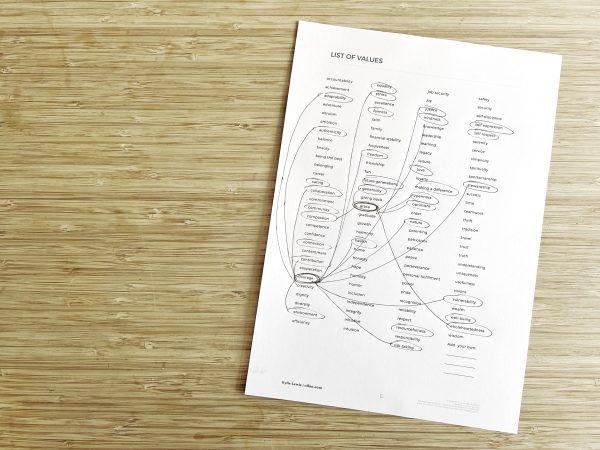
Circle everything on the list that has resonance or appeal to around 10-15 values. The task may seem hard at first, but trust yourself to narrow them down.
Try to avoid values you think you ‘should’ have (this was my ‘good mother values’ pitfall). There are no right or wrong values. Your choices are not for being judged by others.
Step 3: Group your values into clusters
Group your values into clusters that you feel fit together and overlap.
Then look for two values that might operate as umbrella values for a cluster of values. Or, put another way, what might be ‘trunk’ values that feed into a root system of other values?
For example, the umbrella/trunk value of ‘courage’ can represent a cluster/root system of values, which includes curiosity, ethics, learning, integrity, risk-taking, leadership, cooperation and self-expression.
Step 4: Embrace Imperfection
Give up on the idea of perfection. This is just your best guess today. Your values can be an aspiration rather than a reflection of where you’re at.
It’s possible for values to shift as time progresses or as you gain a deeper understanding of yourself. But mostly, your values are baked-in and often reconfirmed by your life experiences. Try them on and see how they feel. If they don’t feel right, you can continue to think about it.
Should you think about your values at work or in family life?
Ideally, your values are consistent across your personal and professional life. If not, there can be a strain. It’s best to consider your values at their root.
Your core values represent who you are as a whole, integrated person, no matter which arena of your life you show up in (personal or professional, public or private).
Step 5: More than fluff – turn values into action
In my years of coaching and facilitating, most people want to live their life with a sense of purpose, clarity, meaning and cohesion. They will stay that integrity is important. Here’s a definition of integrity that’s useful to consider:
‘Integrity is choosing courage over comfort. It’s choosing what’s right over what’s fun, fast or easy. It’s choosing to practice our values, rather than just profess them.’ – Brené Brown
To live with integrity is to show up in our lives aligned with our values. So here are a few questions to consider for each of your values:
- What’s one example of a behaviour that lives into your value?
- What’s one example of a behaviour that is outside of your value?
- When is a time when you’ve lived into your values?
One of my values is courage. So here are my answers:
- Doing things I don’t know how to do and feel uncertain about
- Procrastinating, overthinking, perfectionism
- Wrote and presented a presentation to a group of brilliant women I initially felt intimidated by
Now, I use my values regularly to check in with how I’m showing up in my life.
In the Dare to Lead™ program, living into values is a core behaviour of courageous leadership. So next time you’re making a decision, invite your values to the table and run your options through your values filter by asking:
- Is this who I want to be?
- Is this who I am at my best?
- Which decision is aligned with my values and helps me live into my integrity?
Share Your Values
Living into values isn’t always easy. And it’s not something you need to do on your own. Share your values with people who will help you live into them when you’re under pressure or feeling uncertain. My best friend will often say to me, ‘what does courage look like for you in this situation?‘ It’s such a helpful question to be asked that roots me back into purpose and aspiration for my life. Including what my version of being a great mum looks like.
Leave a comment below and let me know what your values are!
What’s Next?
Complete this exercise about living into our values.
Listen to Brené Brown on the Unlocking Us podcast speaking about living into our values, where she walks through the exercise step by step
Book a ‘Values-Led Leadership‘ webinar with your team to do this exercise together and increase your trust as a team. Read more about that here.







Leave A Comment